Personality trait predictors of healthcare use: A coordinated analysis of 15 samples
Emily C Willroth, Jing Luo, Olivia E Atherton, Sara J Weston, Johanna Drewelies, Philip J Batterham, David M Condon, Denis Gerstorf, Martijn Huisman, Avron Spiro, Daniel K Mroczek
*Journal of Personality and Social Psychology*
Abstract
Some people use healthcare services more than others. Identifying factors associated with healthcare use has the potential to improve the effectiveness, efficiency, and equity of healthcare. In line with the Andersen behavioral model of healthcare utilization and initial empirical findings, personality traits may be key predisposing factors associated with healthcare use. Across 15 samples, the present study examined cross-sectional and prospective associations between Big Five personality traits and the likelihood of dental visits, general medical practitioner visits, and hospitalizations. Using coordinated data analysis, we estimated models within each of 15 samples individually (sample Ns ranged from 516 to 305,762), and then calculated weighted mean effect sizes using random effects meta-analysis across samples (total N = 358,803). According to the synthesized results, people higher in conscientiousness, agreeableness, extraversion, and openness, and lower in neuroticism were more likely to visit the dentist; people higher in neuroticism were more likely to visit general medical practitioners; and people lower in conscientiousness and agreeableness and higher in neuroticism were more likely to be hospitalized. Associations tended to be small with odds ratios around 1.20 (rs approx .05). These findings provide evidence across 15 international samples for small but consistent associations between personality traits and healthcare use and demonstrate that personality-healthcare associations differ by type of care.
Why we asked
Some people go to the doctor and dentist regularly, and others rarely do. Understanding why could help make health care work better and more fairly. Personality is a plausible piece of the answer, but earlier studies used single samples and disagreed with each other, especially about hospital use. We wanted to know whether the associations replicate when the same question is asked in many datasets.
What we did
We ran a coordinated analysis, which means every team applies identical models and code to its own dataset, and the results are combined with meta-analysis. We had 15 samples from the United States, Germany, Australia, the Netherlands, Sweden and Japan, with a combined N of 358,803. In each sample we asked whether each Big Five trait was associated with visiting a dentist, visiting a general practitioner, and being admitted to a hospital, adjusting for age and sex. We preregistered the questions and hypotheses. The traits were the same in every sample, but the questionnaires were not, so we standardized scores within each study.
What we found
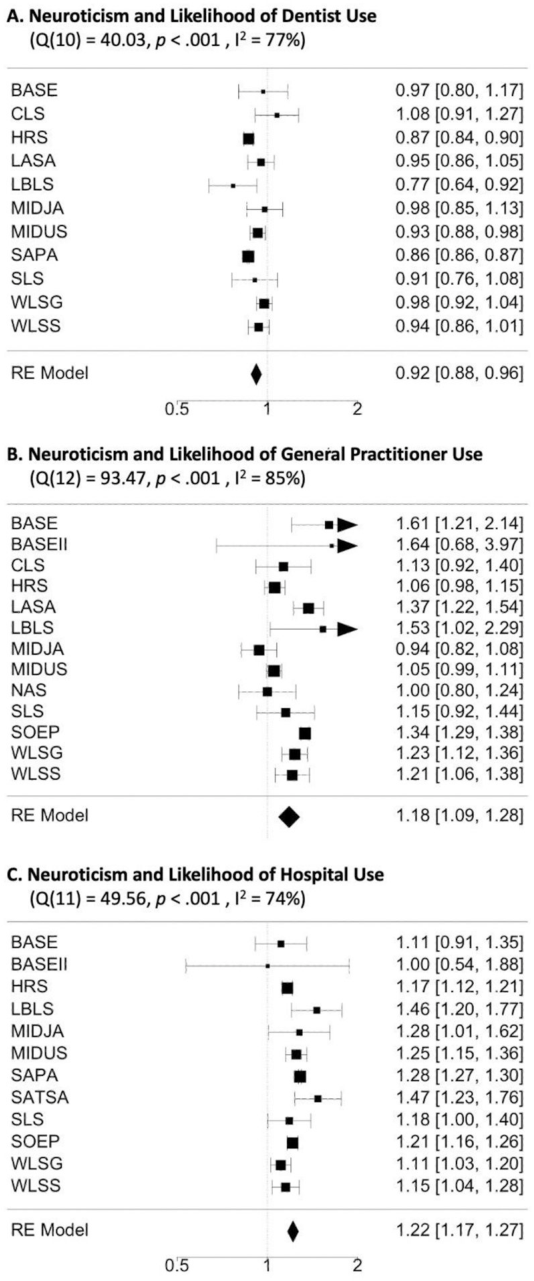
The associations were small, with odds ratios around 1.20 (correlations of about .05), but many of them pointed the same way across samples. People higher in conscientiousness, agreeableness, extraversion and openness, and lower in neuroticism, were more likely to visit the dentist. People higher in neuroticism were more likely to see a general practitioner. People higher in neuroticism and lower in conscientiousness were more likely to be hospitalized. The neuroticism and hospitalization association was positive in 10 of 12 samples.
We had predicted that neuroticism would go with more dentist visits, and the opposite happened. Dental anxiety could be part of the reason, but that is speculation.
What it means
Broad personality traits are one modest factor among many in who uses care. Because the data are correlational, we cannot say that traits cause any of this, and we cannot tell appropriate use from overuse or underuse. Narrower facets of personality and more specific kinds of care would be a better test.
Personality relates to health care, and it relates differently to different kinds of care.