Who Are the Scrooges? Personality Predictors of Holiday Spending
Sara J Weston, Joe J Gladstone, Eileen K Graham, Daniel K Mroczek, David M Condon
*Social Psychological and Personality Science*
Abstract
The sharp increase in consumption over the holiday season has important economic implications, yet the psychology underlying this phenomenon has received limited attention. Here, we evaluate the role of individual differences in holiday spending patterns. Using 2 million transactions across 2,133 individuals, we investigate the relationship between the Big 5 personality traits on spending at Christmas. Zero-order correlations suggest holiday spending is associated with conscientiousness, neuroticism, and extraversion; the relationship with neuroticism persists after accounting for possible confounders including income and demographics. These results improve our understanding of how different personality traits predict how people respond to the environmental demands of the holiday season and have broader implications for how personality relates to consumer behavior.
Why we asked
Spending jumps every November and December, and retailers, economists and marketers have studied that jump for a long time. Much less is known about who spends more. We suspected that personality would be part of the answer, because the holidays combine gift-giving, parties and stress, and people differ in how they handle all three. We had guesses about extraversion (more friends, more gifts) but no strong theory for the other traits, so we called the study exploratory and preregistered our expectations anyway.
What we did
A UK money-management app pulled together people’s bank and credit card accounts, and its users agreed to link their transactions to a short personality survey. We had 2,133 people and about 2.2 million transactions. We added up what each person spent in November and December, then asked how that total was associated with each Big Five trait, adjusting for age, gender, income and how much the person normally spent. The personality survey had only ten items, and some of the trait scales were not very reliable, so we treated those results with caution.
What we found
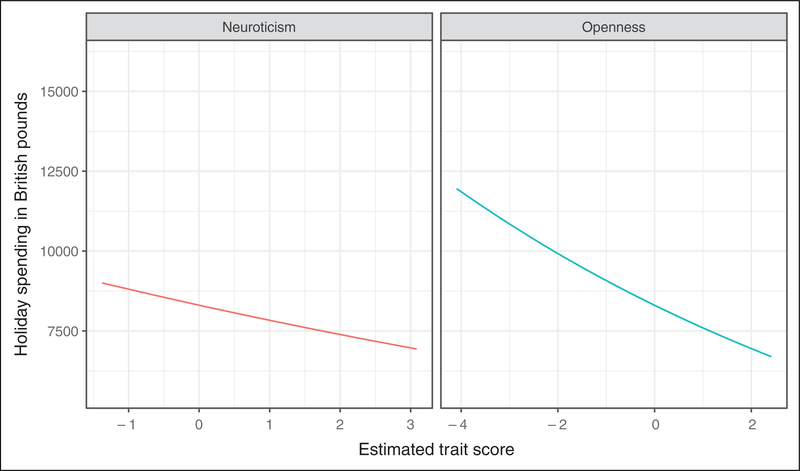
Before adjustment, people higher in conscientiousness and extraversion spent somewhat more, and people higher in neuroticism spent less. After adjustment, higher neuroticism and higher openness were each associated with spending less. In other words, people who described themselves as more nervous or more imaginative spent a little less over the holidays than otherwise similar people. Conscientiousness was only weakly associated with spending, and we did not count that as solid evidence. We found no sign that traits were linked to when people shopped.
All of these associations were small. That is not surprising, since household size, and income from several sources all shape a person’s holiday bill.
What it means
We can only speculate about the reasons. People high in openness may be less tied to gift-giving norms, and people high in neuroticism may be less inclined to splash out on the perfect present. Our sample was not representative of the UK, and it had a lot of missing gender information, so the results describe these app users.
Personality is one small piece of the holiday bill.