The relationship between career success and sense of purpose: Examining linkages and changes
Sara J Weston, M Teresa Cardador, Patrick L Hill, Ted Schwaba, Jennifer Lodi-Smith, Susan K Whitbourne
*The Journals of Gerontology: Series B*
Abstract
Objectives: Although researchers have linked sense of purpose to working status, there are few studies examining how specific characteristics of work may correlate with sense of purpose. The aim of the current study is to extend prior research by assessing the degree to which objective and subjective forms of career success, occupational prestige and work satisfaction, are associated with levels of and changes in sense of purpose. Method: Participants were part of the Rochester Adult Longitudinal Study (RALS; N = 307), which contains multiple cohorts of participants each assessed at multiple waves (full age range: 42 to 71). We used cross-lagged modeling to test the relationships in our model. Results: Occupational prestige was not associated with sense of purpose levels and change. However, work satisfaction was positively associated with higher levels of sense of purpose initially, and there was evidence that changes in the two constructs were positively correlated. Discussion: These findings suggest that subjective career success may be more important for sense of purpose than more objective indicators. Findings are discussed with respect to study limitations and guidance for future researchers using secondary data.
Why we asked
Work gives many people a sense of direction, and people who lose their jobs tend to lose some of that purpose. Yet jobs differ, and we know little about which features of work matter. We looked at two. Occupational prestige is the esteem society gives a job, and it is an objective marker of career success. Work satisfaction is how a person feels about their own work situation, and it is a subjective one. We expected both to be associated with purpose, and we allowed that purposeful people might also move toward more prestigious or satisfying work.
What we did
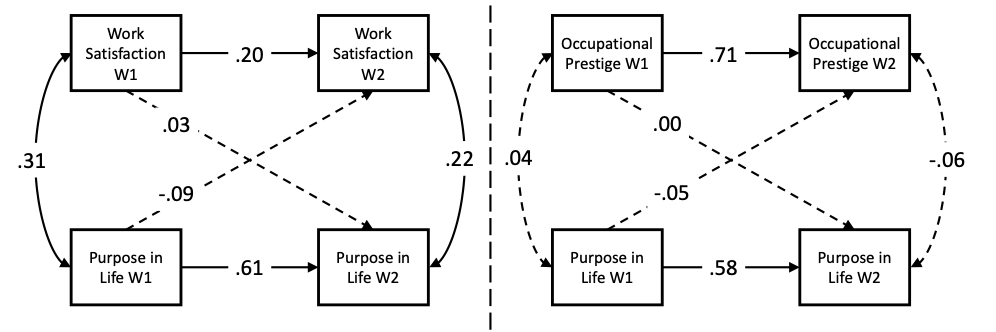
We used the Rochester Adult Longitudinal Study, which follows University of Rochester alumni. Our 307 participants completed the same measures in 2000 to 2002 and again in 2012 to 2014, when they were between 42 and 71. We fit cross-lagged panel models, which ask whether each variable at the first wave predicts change in the other at the second. We preregistered our plan, and after peer review we replaced our original models with these.
What we found
Occupational prestige was unrelated to purpose at either wave (r = .04 at baseline). Work satisfaction was clearly related (r = .31). Neither variable predicted later change in the other. Among people whose satisfaction rose relative to their peers, purpose also tended to rise (r = .22). In other words, the two moved together, but we cannot tell which came first. Prestige showed no such link.
Purpose and prestige were both relatively stable over twelve years, which leaves little change to explain. Our sample was small, made up of alumni, and only a third of the eligible cohort, and work satisfaction was a single question. Two waves cannot tell us how the two develop together.
What it means
Whether people find work satisfying appears to matter more for purpose than how prestigious their job is. The paper also reflects on what we learned from preregistering an analysis of existing data.
The PDF here is our author preprint. The published version is available through the DOI.