How do people respond to health news? The role of personality traits
Sara J. Weston, Joshua J. Jackson
*Psychology & Health*
Abstract
When a patient receives a health diagnosis, their response (e.g., changes in behavior, seeking support) can have significant consequences for long-term health and well-being. Characteristics of health news are known to influence these responses, but personality traits have been omitted from this line of research. The current study examines the role of personality traits in predicting response to health news. Participants (N = 298) read scenarios in which they received health news that was manipulated to vary in severity, controllability and likelihood of outcomes. Participants then rated how likely they were to engage in a number of response behaviors. We examined the main effects and interaction of situational manipulations and personality traits on ratings of these behaviors. Both situations and personality traits influenced behavioral responses to health events. In particular, conscientiousness predicted Taking Action and Seeking Social Support. Neuroticism predicted both maladaptive and adaptive behavioral responses, providing support for the "healthy neurotic" hypothesis. Moreover, personality traits predicted best in weak (unlikely, controllable) situations. Both personality traits and situational characteristics contribute to behavioral responses to health news.
Why we asked
When a doctor delivers worrying news, what a person does next can matter nearly as much as the news. One person books the procedure that afternoon, another reads everything they can find, and a third tells no one and hopes it goes away. Earlier work showed that features of the news shape these choices, such as how likely, severe, and controllable the outcome is. It said little about the person hearing the news. We suspected personality would matter, particularly conscientiousness and neuroticism, the two traits most consistently linked to health.
What we did
We asked 298 adults, recruited through Amazon Mechanical Turk, to read two hypothetical scenarios: a suspicious mole on their own back and a lump found by their spouse. In each, we varied at random whether the possible condition was severe, controllable, and likely. Participants rated how likely they would be to do each of 23 things, from researching the condition to updating a will, and completed a personality questionnaire. We used a factor analysis to see which responses go together, so the ratings told us the categories.
What we found
The ratings sorted into five styles: avoiding the problem, gathering information, taking action, adjusting expectations, and seeking social support. The situation mattered in ways that mostly matched earlier work. For example, participants said they were more likely to take action when the problem was more likely to be real.
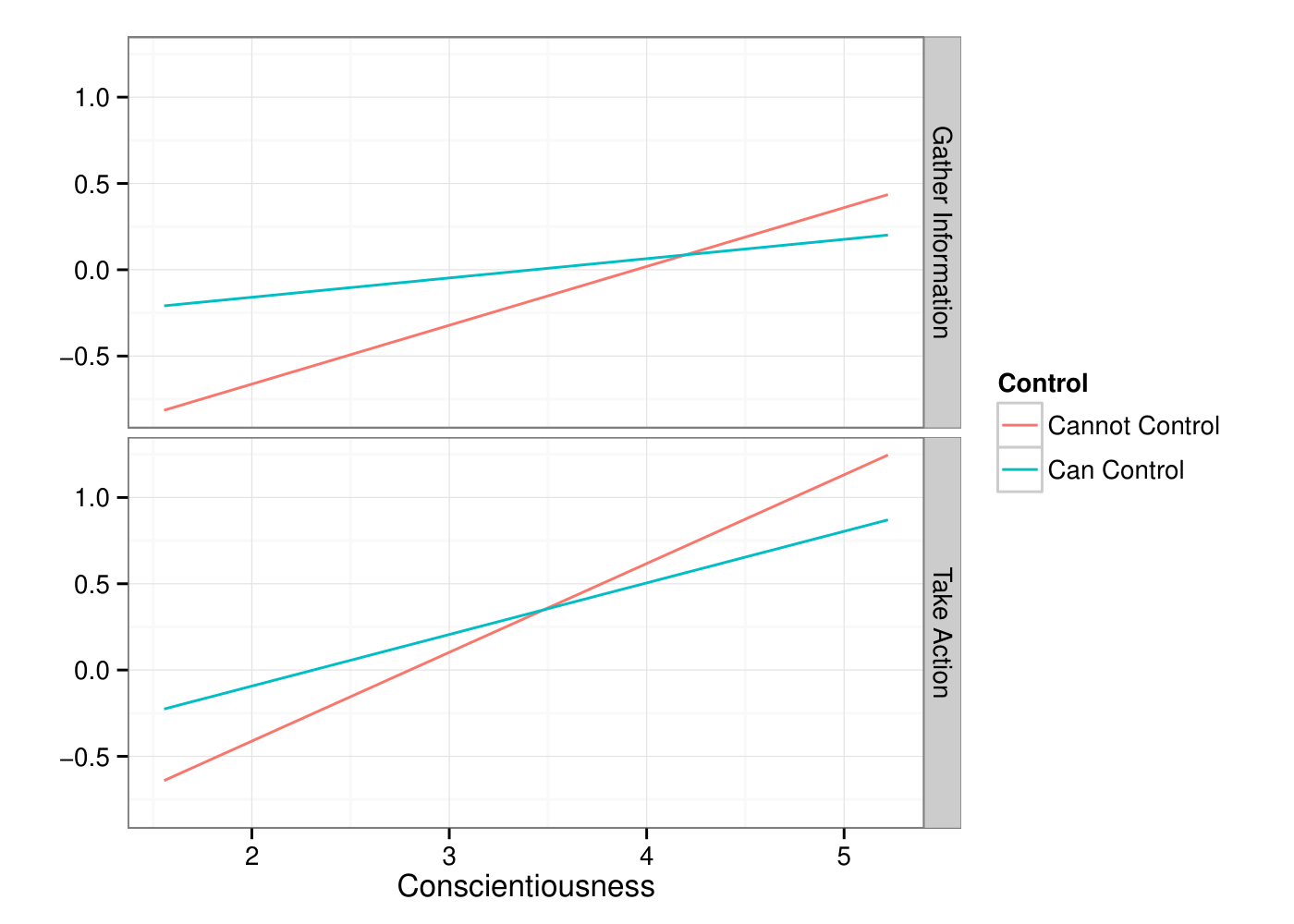
Personality was associated with responses above and beyond the situation. More conscientious people reported being more inclined to take action (b = 0.26) and to seek support (b = 0.18). People higher in neuroticism reported being more inclined toward all five responses (b = 0.13 to 0.20), including both avoiding the problem and acting on it. In other words, neuroticism went with doing more of everything, not with acting more healthily. High neuroticism paired with high conscientiousness did not stand out, which is what the “healthy neurotic” idea would lead one to expect.
Personality showed up most when the situation asked less of people. Conscientiousness was more strongly related to taking action when the outcome could not be controlled, and neuroticism was more strongly related to avoidance when the outcome was unlikely. We suspect a clear, serious situation leaves less room for personality, although this is speculation.
What it means
Responses to health news vary, and part of that variation tracks personality. These are intentions in imagined scenarios, so we cannot say what the same people would do in a doctor’s office. Studies of real diagnoses come next.
The PDF here is our author preprint. The published version is available through the DOI.