Body mass in US adolescents: Stronger ties to socioeconomic status than personality
Sara Weston, Magdalena Leszko, David Condon
*Personality Science*
Why we asked
Researchers have linked adolescent body mass to family socioeconomic status, to cognitive ability, and to personality. Those factors overlap with one another, and few studies had asked how much each one matters once the others are in the model. That question matters for anyone deciding where to put effort. If personality carries most of the weight, interventions might aim at personality. If family resources carry it, they should aim elsewhere.
What we did
We used data from the SAPA Project, a personality website where visitors get feedback on their scores. Our sample was 9,481 US adolescents aged 11 to 17 who reported their height and weight, about two thirds of them girls. We converted their self-reported BMI to a percentile for their age and sex. Then we fit one regression per trait, 33 in all (cognitive ability, the Big Five, and 27 narrow traits), each including parental SES and analyzed separately for girls and boys. We preregistered our hypotheses. Finally, in an exploratory step, we used lasso regression to see how well each set of variables predicted BMI percentile in a held-out quarter of the sample.
What we found
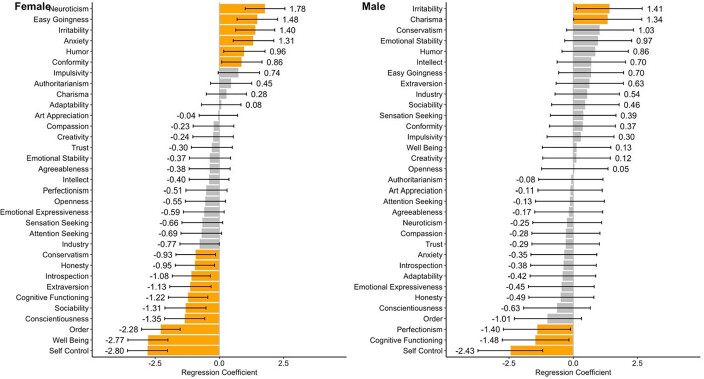
Parental SES was associated with lower BMI percentile in every model. A one standard deviation increase in SES went with a drop of about 3.7 percentile points for girls and 3.5 for boys. Cognitive ability was also associated with lower BMI percentile. Among girls, neuroticism, irritability, and anxiety went with higher BMI percentile, while self-control, order, and conscientiousness went with lower. Among boys, only a few narrow traits stood out. The association between personality and BMI did not consistently depend on SES.
The prediction results put these sizes in context. For girls, SES alone accounted for about 2.2% of the variance in BMI percentile. Adding the Big Five did not help, and adding the narrow traits raised the figure to 4.4%. Everything together explained less than 5%.
What it means
Family SES was more strongly associated with adolescent BMI than any individual difference we measured, although all of these associations are modest. BMI is affected by many things we did not measure. Because our data are cross-sectional and self-reported, we cannot say what drives the links. Taken together, our results point toward systemic influences, and away from individual behavior, as the place to look.