Associations for sense of purpose with smoking and health outcomes among adults with diabetes
Sara J Weston, Patrick L Hill, Daniel K Mroczek
*International Journal of Behavioral Medicine*
Why we asked
Managing diabetes takes a lot of daily behavior: taking medication, eating and moving in particular ways, and not smoking. Psychological resources that shape those behaviors are natural targets for support. Sense of purpose, the feeling that your life has direction and goals, has been linked to better health in general samples. We did not know whether the same holds for people who already have diabetes.
What we did
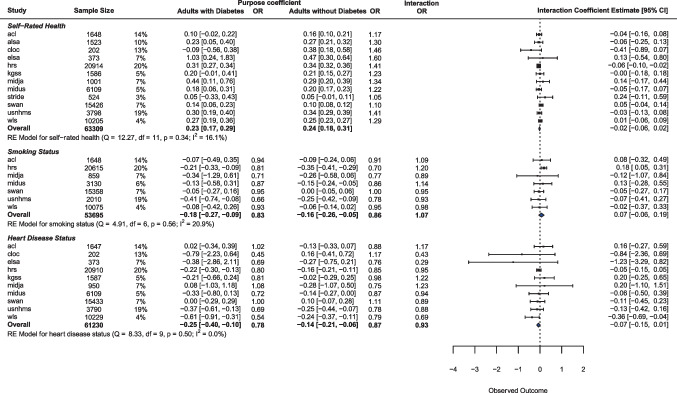
We used a coordinated analysis, meaning we ran the same preregistered models in many independent datasets and combined them with meta-analysis. We found 12 datasets with measures of purpose, diabetes status, and at least one of three outcomes: self-rated health, current smoking, and heart condition. Eight of them followed people over time. Together they included 7,277 adults with diabetes. Models adjusted for age, education, sex, and race.
What we found
In the cross-sectional models, purpose was associated with all three outcomes. Higher purpose went with better self-rated health (b = 0.23, p < .001), lower odds of smoking (OR = 0.83), and lower odds of a heart condition (OR = 0.78). Put plainly, a person with a stronger sense of purpose had about 17% lower odds of being a smoker. These are modest associations. Smoking and heart disease reached significance in only a few individual datasets, mostly the large Health and Retirement Study, but the estimates pointed the same way in nearly all of them. That is what we would expect if small samples, rather than real differences between datasets, were hiding the pattern.
The longitudinal results were thinner. Purpose was associated with later self-rated health, and that held with the Health and Retirement Study removed. The smoking and heart-condition associations did not. Purpose was not associated with changes in any outcome over time.
What it means
Sense of purpose travels with better health among adults with diabetes, but our data cannot say that purpose causes it. We would want studies of mechanisms, such as regular checkups, before anyone builds an intervention on this. We also could not separate type 1 from type 2 diabetes.