Is healthy neuroticism associated with chronic conditions? A coordinated integrative data analysis
Sara J Weston, Eileen K Graham, Nicholas A Turiano, Damaris Aschwanden, Tom Booth, Fleur Harrison, Bryan D James, Nathan A Lewis, Steven R Makkar, Swantje Mueller, others
*Collabra: Psychology*
Why we asked
Neuroticism is usually tied to poor health. Yet the evidence is mixed enough that some researchers have suggested a “healthy neurotic” exists: someone who worries about their health, and who is conscientious enough to act on that worry by seeing a doctor, taking medication, and catching problems early. Earlier studies that supported this idea were small and used different measures, so it was hard to know whether the pattern was real. This paper is the second of three we ran to test it. The others looked at mortality and at health behaviors.
What we did
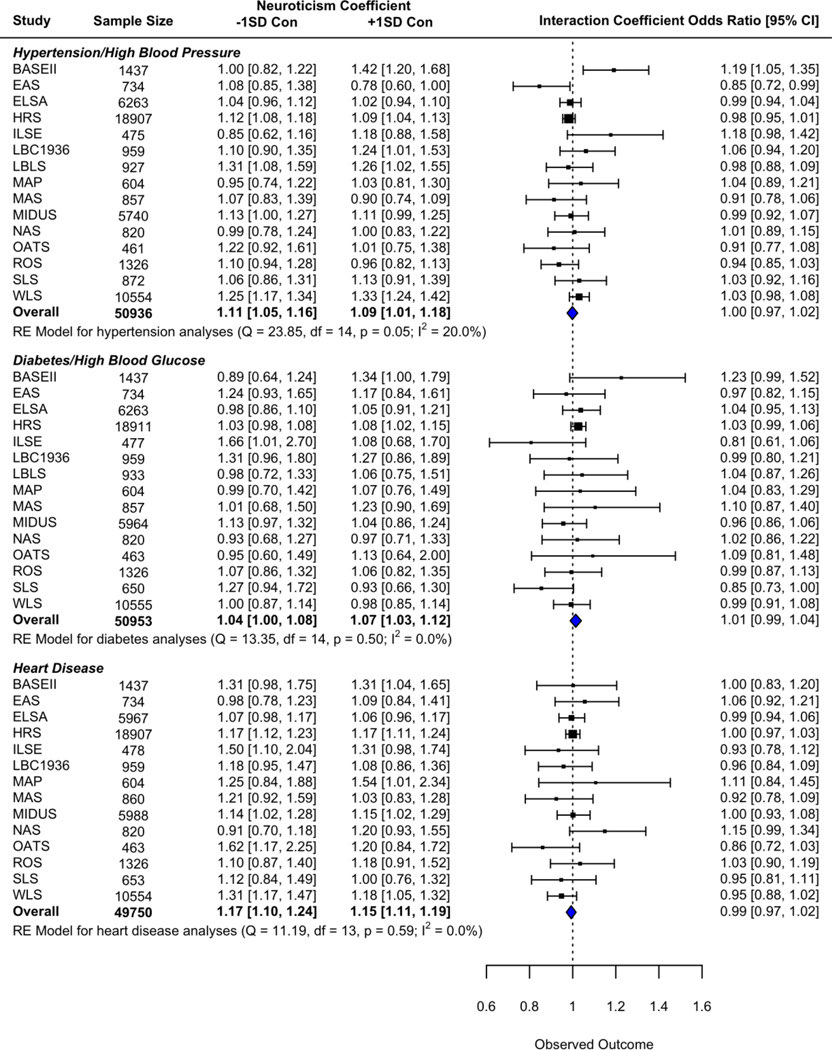
We used a coordinated analysis, which means we preregistered one analysis and ran the same script on many independent datasets, then combined the results. Here we used 15 longitudinal studies (more than 49,000 people in all). For each study we asked whether the association between neuroticism and hypertension, diabetes, or heart disease depended on conscientiousness. We asked this two ways: whether people had the condition at the start of the study, and whether they developed it later.
What we found
Conscientiousness did not change the association between neuroticism and any of the three conditions. At baseline, the pooled odds ratios for the interaction were 1.00 for hypertension (95% CI [0.98, 1.02]) and 0.99 for heart disease (95% CI [0.97, 1.01]), with diabetes just as close to 1. In other words, the link between neuroticism and having the condition looked the same in highly conscientious people and in less conscientious people. The prospective results told the same story. Odds ratios for newly diagnosed hypertension, diabetes, and heart disease ranged from 0.98 to 0.99. Differences between studies were small, with one exception, so the null result looks consistent across samples and personality measures.
What it means
Together with the mortality paper, this points away from healthy neuroticism as a general explanation for the mixed neuroticism and health findings. Conscientiousness may nudge health behaviors a little, but we found no sign that the nudge shows up in chronic disease. Our samples came largely from Western countries, so we cannot say what happens elsewhere. We also suspect that some of the earlier variation across studies was noise rather than a hidden moderator. Researchers who study neuroticism and health should look for other moderators or contexts, such as a recent health scare.