Is healthy neuroticism associated with longevity? A coordinated integrative data analysis
Nicholas A Turiano, Eileen K Graham, Sara J Weston, Tom Booth, Fleur Harrison, Bryan D James, Nathan A Lewis, Steven R Makkar, Swantje Mueller, Kristi M Wisniewski
*Collabra: Psychology*
Why we asked
Personality researchers have argued for years about whether neuroticism, the tendency toward worry and emotional ups and downs, shortens life. Some studies find that it does, some find nothing, and a few find that highly neurotic people live longer. One idea that could reconcile these results is “healthy neuroticism.” A person who worries about their health may be the person who books the checkup and takes the symptom seriously, and if that person is also conscientious (organized, disciplined), the worry might turn into useful action. We wanted to test that idea head on. Is neuroticism a risk for dying earlier only when conscientiousness is low?
What we did
A single study rarely settles a question like this, because studies differ in how they measure personality, what they adjust for, and how long they follow people. So we used a coordinated analysis. In other words, we wrote one analysis script, preregistered it, and had analysts at 12 longitudinal studies (total N = 44,702) run the identical model on their own data. We then pooled the results with meta-analysis. Every model adjusted for age, gender, education, and the other three Big Five traits.
What we found
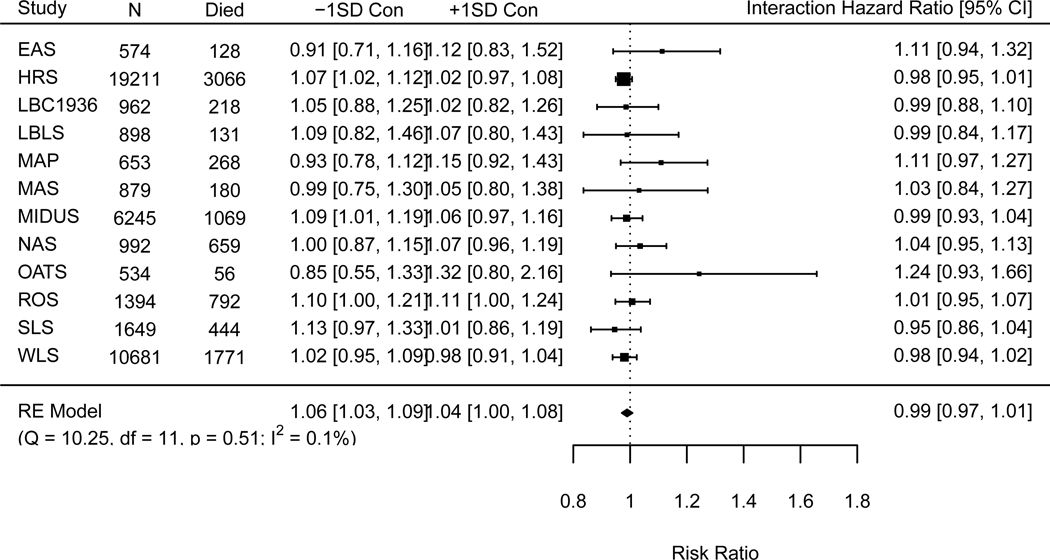
Conscientiousness looked the way earlier work predicted. Higher conscientiousness was associated with a lower hazard of dying (pooled HR = 0.88, 95% CI [0.84, 0.93]), which means people higher in the trait had a lower risk of dying at any given point during follow-up. Neuroticism was less consistent. It was associated with a higher hazard in only three of the 12 studies, and the pooled estimate was small (HR = 1.05, 95% CI [1.02, 1.07]).
The interaction was the question we cared about, and it was essentially zero. The pooled interaction hazard ratio was 0.99 (95% CI [0.97, 1.01]), and none of the 12 studies showed a significant interaction. Because the studies were large, we had enough power to detect an interaction if one existed. At reviewers’ request we also ran models without the other Big Five traits. Neuroticism then looked protective in two studies, but we did not preregister that analysis and we put little weight on it.
What it means
We found no evidence that high conscientiousness turns high neuroticism into an asset for longevity, at least when both traits are measured at the broad level. Speculatively, the idea may hold for narrower pieces of these traits, such as anxiety or self-discipline, which our broad scores could not separate. Studies that test facets are the natural next step.