A Lifespan perspective on the interconnections between personality, health, and optimal aging
Daniel K Mroczek, Sara J Weston, Emily C Willroth
*Personality and Healthy Aging in Adulthood*
Why we wrote it
Nobody becomes a healthy 85-year-old at 85. The habits and choices that lead there start decades earlier, and personality shapes many of them. Researchers have known for some time that traits such as conscientiousness predict health and longevity. This chapter, written for a handbook on personality and healthy aging, asks how that link plays out across a whole life. It is a conceptual chapter, not a report of new data.
Long chains
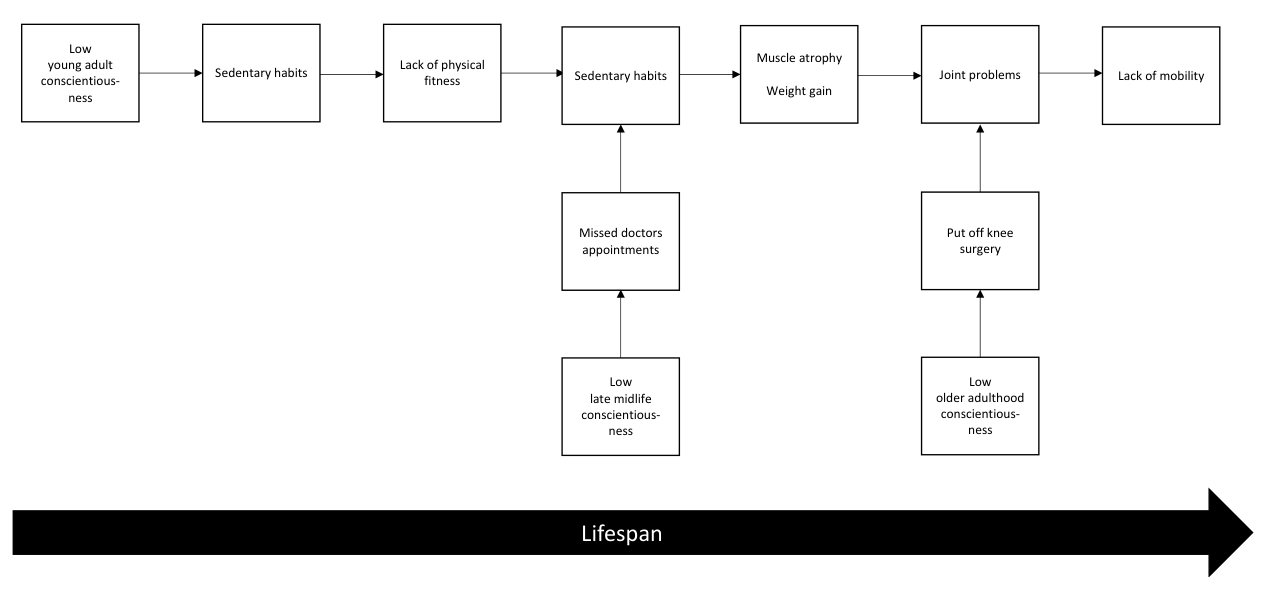
We start with the idea, borrowed from David Barker’s work, that outcomes in old age can trace back through long chains of earlier events. Our example is a person who is low in conscientiousness as a young adult. That person may settle into sedentary habits, which lead to less fitness, then weight gain and joint problems, and eventually less mobility. Lower conscientiousness later in life can add to the chain, for instance when someone skips doctor visits or puts off knee surgery. Personality can therefore act early and far from the outcome, or late and close to it.
Feedback loops
Chains are tidy, and real lives are not. We spend much of the chapter on bidirectionality, where personality changes health and health changes personality. Conscientiousness and academic engagement, for example, have been shown to reinforce each other over time. We can also imagine a less welcome loop, running from high neuroticism to high blood pressure, which produces anxiety, which sustains the neuroticism. In such loops it becomes hard to say which variable is the cause, and we suggest that healthy aging is likely the product of many of them running together. We also note that the same trait may matter for different reasons, or to different degrees, at different ages.
Targeting and tailoring
Finally, we consider what this means for interventions. If people differ, a single program for everyone may work poorly. We describe “targeting,” where a group defined by a trait gets a matched intervention, and “tailoring,” where an intervention is built for one person. Both remain largely hypothetical, and we say so. Someone moderately high in neuroticism might benefit from meditation, while someone extremely high might need cognitive behavioral therapy. That example is speculation, and it needs testing.
Personality is one piece of a much larger picture of how people age well.