A guide for many authors: Writing manuscripts in large collaborations
Hannah Moshontz, Charles R Ebersole, Sara J Weston, Richard A Klein
*Social and Personality Psychology Compass*
Abstract
Writing manuscripts collaboratively affords both opportunities and challenges: Collaborative papers can benefit from the expertise, perspectives, and collective effort of the group but can lack coherence or be produced inefficiently. When collaborations are large, involving tens or hundreds of researchers, there are more and different opportunities and challenges, like appropriately crediting the contributions of many people. This paper is a practical guide for authors writing collaborative manuscripts, particularly those working in large collaborations. We emphasize the importance of deliberate leadership and describe five general strategies that lead authors can employ to maximize opportunities and navigate challenges: care in recruiting the author team, care in crediting the author team, clear and frequent communication, organized materials, and deliberate and early decision-making. For each, we offer specific tips in line with these strategies (e.g., use collaboration agreements, leverage Open Science practices). We then suggest how lead authors can structure the writing and revising process to produce a coherent manuscript and offer tips for submitting papers and responding to peer-reviews. A repository of resources for people writing manuscripts in collaborations is available at osf.io/dzwcn.
Why we wrote it
Large collaborations are now common in psychology, and so are papers with dozens or hundreds of authors. More authors bring more expertise and more chances to catch a mistake. They also bring slow drafts, mismatched writing styles, and arguments about who gets credit. Each of us had led or contributed to big collaborative manuscripts, and we kept running into the same problems, so we wrote down what we had learned. This is a guide based on our experience, not an empirical study of team writing.
What the guide covers
We argue that a large paper needs deliberate leadership, meaning someone (or a small group) takes explicit responsibility for getting it done. We then describe five strategies for lead authors. First, recruit the author team with care, and ask whether the project needs a large team at all. Second, decide how authorship will be awarded before people start working, and describe each person’s contribution explicitly rather than relying on author order. Third, communicate clearly and often, ideally by answering three questions for everyone: what should I be doing right now, how should I do it, and when is it due. Fourth, keep materials organized so that nobody edits an old draft. Fifth, make decisions early, and be clear about which ones the whole group will weigh in on.
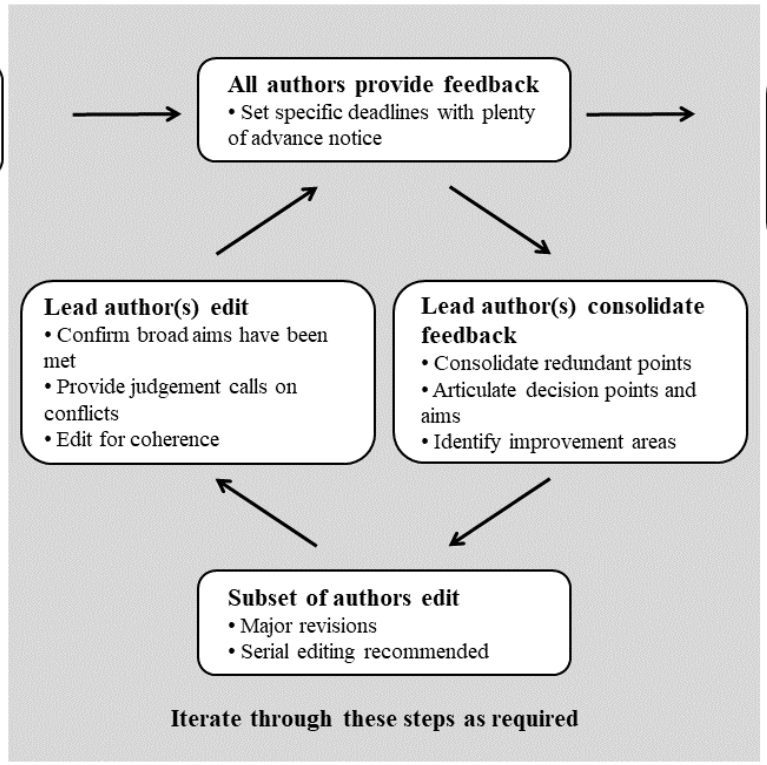
We also lay out a way to structure the writing itself. One person drafts, all authors give feedback on a set deadline, the lead authors consolidate that feedback, a smaller group makes the major revisions, and the cycle repeats until the lead authors finalize the draft. We close with tips for submission and for responding to reviewers.
What it means
The advice is simple to state and hard to do when a project is already underway. For example, agreeing on authorship criteria on day one is much easier than settling it after two years of work. Practices we already use for other reasons, such as preregistration and Registered Reports, also help here because they force decisions to be made early.
We also keep a repository of resources on OSF for anyone leading a collaborative paper.