Is healthy neuroticism associated with health behaviors? A coordinated integrative data analysis
Eileen K Graham, Sara J Weston, Nicholas A Turiano, Damaris Aschwanden, Tom Booth, Fleur Harrison, Bryan D James, Nathan A Lewis, Steven R Makkar, Swantje Mueller
*Collabra: Psychology*
Why we asked
Neuroticism is usually linked to worse health. Yet some people who worry a lot are also organized and careful, and personality psychologists have long argued that this combination might be healthy. The idea is called healthy neuroticism, and the evidence has been mixed. We tested it as the neuroticism by conscientiousness interaction: does the association of neuroticism with a health behavior differ for people who are high or low in conscientiousness?
What we did
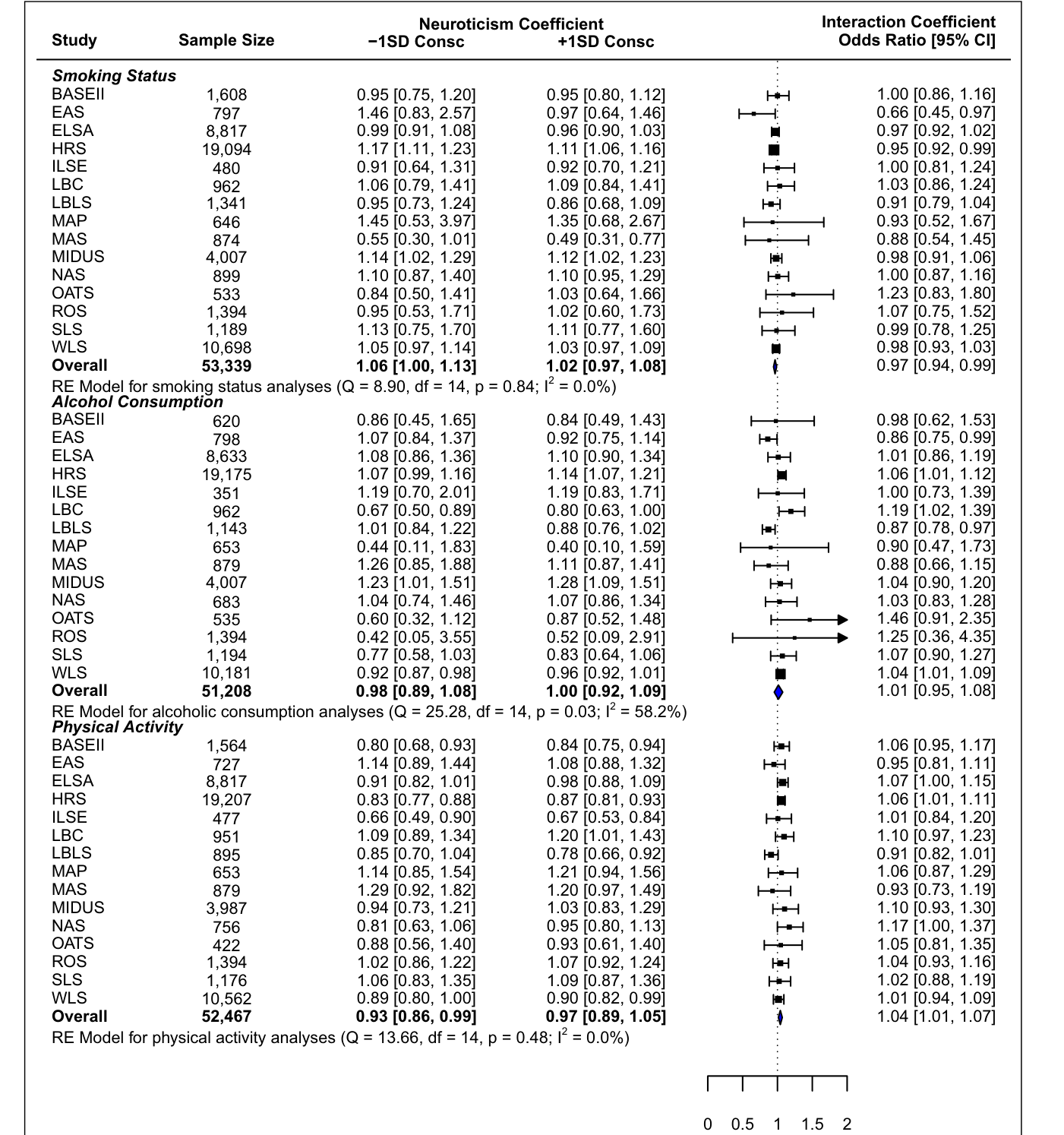
We ran a preregistered coordinated analysis in 15 longitudinal studies, with about 54,000 participants in total. Each study fit the same models with the same covariates and data transformations, so the results could be compared directly. We then combined them in a meta-analysis that weights each study by its sample size and estimates how much the studies disagree. The outcomes were smoking, alcohol consumption, and physical activity, measured at the first wave of each study.
What we found
Neuroticism alone was not related to any of the three behaviors. More conscientious people were less likely to smoke or drink and more likely to be physically active.
For healthy neuroticism, the smoking interaction (OR = 0.97, 95% CI [0.94, 0.99]) and the physical activity interaction (OR = 1.04, 95% CI [1.01, 1.07]) were statistically significant, and alcohol was not. In other words, higher neuroticism went along with more smoking and less activity among people low in conscientiousness, and that pattern was weaker among people high in conscientiousness. The effects are small. Within each study the estimates sat close to null, and the studies agreed with one another closely on smoking and activity, with less agreement on alcohol.
What it means
This is the third of three coordinated analyses of healthy neuroticism. The other two, on mortality and on chronic conditions, found no difference across levels of conscientiousness. Together they suggest that so-called healthy neurotics may have slightly better health behaviors, but not by enough to show up in overall health. We also preregistered twice, once for a preliminary version and once after a change in personnel, and we report both. These data are cross-sectional, so we cannot say the behaviors are caused by these traits.