Longitudinal associations among the Big Five personality traits and healthcare utilization in the US
Olivia E Atherton, Emily C Willroth, Sara J Weston, Daniel K Mroczek, Eileen K Graham
*Social Science & Medicine*
Why we asked
Healthcare use is where a person’s habits meet the health system. Some people book a checkup every year, and others go only when something is wrong. In the United States that pattern also depends on insurance, income, and age, so it is hard to say how much is a matter of the person. We wanted to know whether personality traits help account for who uses which kinds of care, and whether the answer changes with the resources a person has.
What we did
We used three waves of the Midlife in the United States study (MIDUS), which followed 7,108 adults across about twenty years. Participants rated themselves on the Big Five traits and told us how often in the past year they had routine visits (physicals, dental and eye exams), scheduled treatment or surgery, and urgent care.
Our models separate two questions that are easy to blur. The first is between-person: do people who are more agreeable, on average, use more care than people who are less agreeable? The second is within-person: at a wave when the same person is more agreeable than usual, do they use more or less care? We also asked whether age, income, insurance, and chronic conditions changed those associations, and whether a sense of control links traits to care over time.
What we found
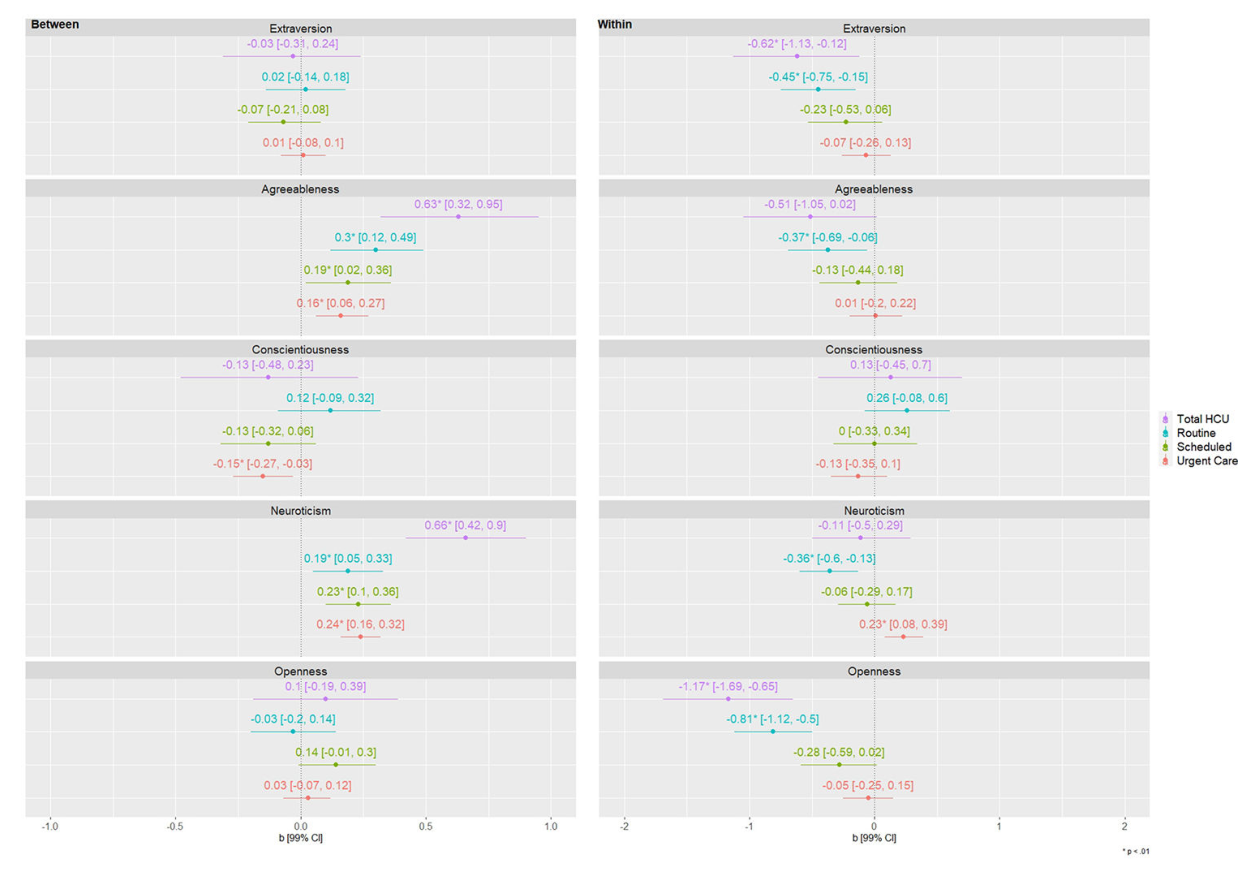
Between people, those who were more agreeable or more neurotic tended to use more care overall, and this held for routine, scheduled, and urgent care. Conscientiousness, which we expected to matter, was largely unrelated to how much care people used. The one exception was that more conscientious people used less urgent care.
Within people, waves when someone was more extraverted or more open went along with fewer visits, mostly routine ones. In other words, the same person tended to see the dentist and the doctor less in periods when they were more outgoing and curious. We can only speculate about why (perhaps they were busy with other things), and we did not test it. The associations were stronger among older adults, and in a couple of cases among people with lower income or less insurance. Sense of control linked several traits to care use in the mediation models, but those indirect effects were small.
What it means
These are associations in self-reported data, so we cannot say that personality changes how people use care. Our conscientiousness measure was also weak (reliability of about .56 to .58), which may have muted its results. Personality is one piece of who uses care, and access is another.