Missing Data

PSY 410: Data Science for Psychology

Dr. Sara Weston

2026-05-13

Why missing data matters

The data you don’t have

In a typical longitudinal psychology study, 30–50% of participants drop out before the final wave.

If you just delete their data, you might be throwing away the most important part of the story — because who drops out is rarely random.

Today we learn to detect, explore, and handle missing data honestly.

Types of missing data

Explicit missing: NA

Explicit missing means you can see the NA:

survey <- tibble(
  participant = 1:5,
  age = c(25, NA, 30, 22, NA),
  depression = c(12, 18, NA, 10, 15)
)

survey
# A tibble: 5 × 3
  participant   age depression
        <int> <dbl>      <dbl>
1           1    25         12
2           2    NA         18
3           3    30         NA
4           4    22         10
5           5    NA         15
The NA values are obvious.

Implicit missing: Rows don’t exist

Implicit missing means entire rows are absent:

appointments <- tibble(
  name = c("Alice", "Bob", "Alice", "Carol"),
  day = c("Mon", "Mon", "Wed", "Wed"),
  attended = c(TRUE, TRUE, TRUE, TRUE)
)

appointments
# A tibble: 4 × 3
  name  day   attended
  <chr> <chr> <lgl>   
1 Alice Mon   TRUE    
2 Bob   Mon   TRUE    
3 Alice Wed   TRUE    
4 Carol Wed   TRUE    

Who didn’t show up? You can’t tell because they’re not in the data!

Why implicit missing matters

In longitudinal studies, missing rows often mean dropout:

# Three-wave study
longitudinal <- tibble(
  id = c(1, 1, 1, 2, 2, 3),  # Person 2 missing wave 3, person 3 missing waves 2 and 3
  wave = c(1, 2, 3, 1, 2, 1),
  depression = c(20, 15, 12, 25, 22, 18)
)

longitudinal
# A tibble: 6 × 3
     id  wave depression
  <dbl> <dbl>      <dbl>
1     1     1         20
2     1     2         15
3     1     3         12
4     2     1         25
5     2     2         22
6     3     1         18

Person 2 and 3’s missing waves are implicit — they’re not NA, they’re just absent.

Exploring missing data

Checking for NAs

survey <- tibble(
  id = 1:6,
  age = c(25, NA, 30, 22, NA, 28),
  depression = c(12, 18, NA, 10, 15, NA),
  anxiety = c(15, 20, 12, NA, 18, 16)
)

# Check if any NAs exist
any(is.na(survey))
[1] TRUE
# Count total NAs
sum(is.na(survey))
[1] 5

NAs by column

# Count NAs in each column
survey |>
  summarize(
    age_missing = sum(is.na(age)),
    depression_missing = sum(is.na(depression)),
    anxiety_missing = sum(is.na(anxiety))
  )
# A tibble: 1 × 3
  age_missing depression_missing anxiety_missing
        <int>              <int>           <int>
1           2                  2               1

Better approach: across()

survey |>
  summarize(
    across(
      everything(),
      ~sum(is.na(.x))
    )
  )
# A tibble: 1 × 4
     id   age depression anxiety
  <int> <int>      <int>   <int>
1     0     2          2       1

Or as proportions:

survey |>
  summarize(
    across(
      everything(),
      ~mean(is.na(.x))
    )
  )
# A tibble: 1 × 4
     id   age depression anxiety
  <dbl> <dbl>      <dbl>   <dbl>
1     0 0.333      0.333   0.167

Which rows have missing data?

# Show only rows with any NA
survey |>
  filter(if_any(everything(), is.na))
# A tibble: 5 × 4
     id   age depression anxiety
  <int> <dbl>      <dbl>   <dbl>
1     2    NA         18      20
2     3    30         NA      12
3     4    22         10      NA
4     5    NA         15      18
5     6    28         NA      16
# Show only complete cases
survey |>
  filter(if_all(everything(), ~!is.na(.x)))
# A tibble: 1 × 4
     id   age depression anxiety
  <int> <dbl>      <dbl>   <dbl>
1     1    25         12      15

Visualizing missingness

The naniar package provides great visualization tools:

library(naniar)

# Visual summary
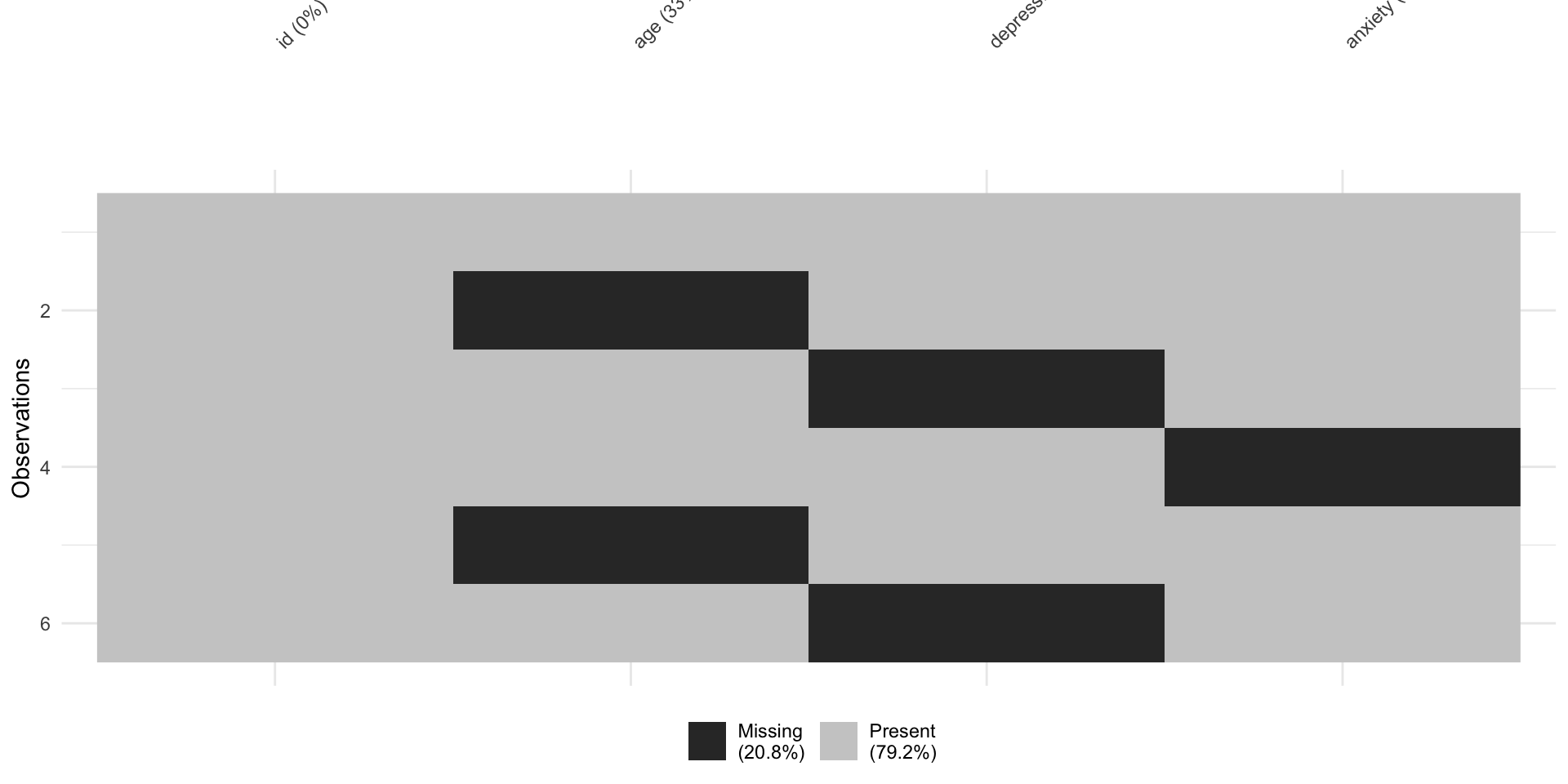
vis_miss(survey)
Heatmap showing the pattern of missing values across all variables in the survey data. Each row is a participant and each column is a variable, with missing cells highlighted to reveal where data gaps occur.

Patterns of missingness

# Are certain combinations of variables missing together?
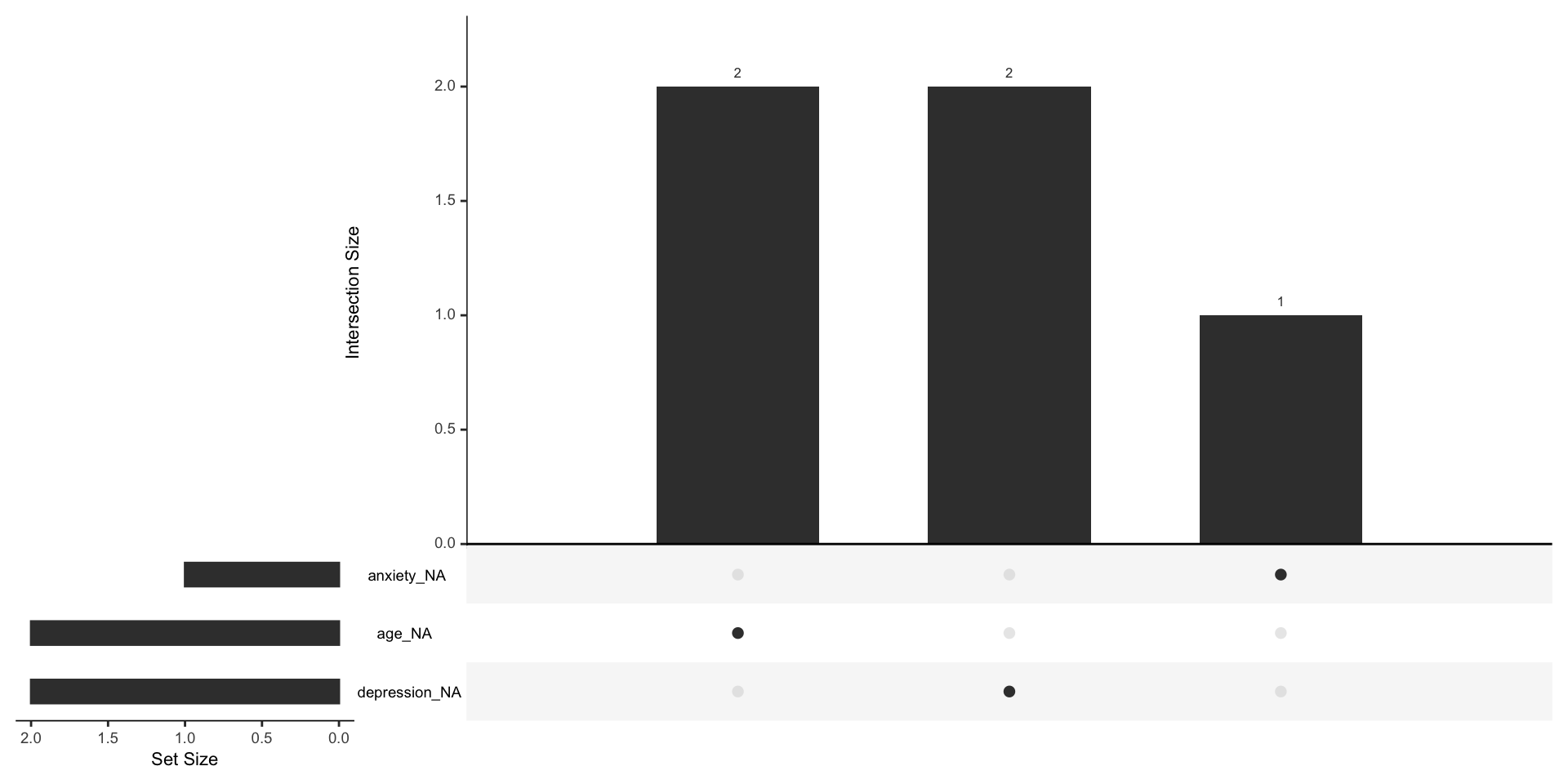
gg_miss_upset(survey)
Upset plot showing which combinations of variables have missing values in the same rows, revealing whether missingness clusters across specific variable pairs.

This shows which combinations of variables are missing in the same rows.

Handling missing data

Strategy 1: Complete case analysis

Complete case analysis (listwise deletion) removes any row with any NA:

# Base R way
na.omit(survey)
# A tibble: 1 × 4
     id   age depression anxiety
  <int> <dbl>      <dbl>   <dbl>
1     1    25         12      15
# tidyverse way
survey |>
  drop_na()
# A tibble: 1 × 4
     id   age depression anxiety
  <int> <dbl>      <dbl>   <dbl>
1     1    25         12      15

Dangers of complete case analysis

# Started with 6 participants
nrow(survey)
[1] 6
# Only 2 complete cases
survey |>
  drop_na() |>
  nrow()
[1] 1

Warning

You just lost 67% of your data!

Selective dropping

Only drop rows missing specific variables:

# Drop only if depression is missing
survey |>
  drop_na(depression)
# A tibble: 4 × 4
     id   age depression anxiety
  <int> <dbl>      <dbl>   <dbl>
1     1    25         12      15
2     2    NA         18      20
3     4    22         10      NA
4     5    NA         15      18
# Drop only if depression OR anxiety is missing
survey |>
  drop_na(depression, anxiety)
# A tibble: 3 × 4
     id   age depression anxiety
  <int> <dbl>      <dbl>   <dbl>
1     1    25         12      15
2     2    NA         18      20
3     5    NA         15      18

When is dropping okay?

Dropping is fine when:

  • Missing data is rare (< 5-10%)
  • Missingness is truly random
  • You have adequate sample size

Be cautious when:

  • Missing data is common (> 20%)
  • Certain groups have more missingness (systematic bias)
  • Sample size is small

Strategy 2: Filling values

Sometimes you can reasonably fill missing values:

# Carry forward the last observation
time_series <- tibble(
  day = 1:5,
  mood = c(5, NA, NA, 4, 6)
)

time_series |>
  fill(mood)  # Fills downward by default
# A tibble: 5 × 2
    day  mood
  <int> <dbl>
1     1     5
2     2     5
3     3     5
4     4     4
5     5     6

Fill directions

# Fill upward
time_series |>
  fill(mood, .direction = "up")
# A tibble: 5 × 2
    day  mood
  <int> <dbl>
1     1     5
2     2     4
3     3     4
4     4     4
5     5     6
# Fill both ways
time_series |>
  fill(mood, .direction = "updown")
# A tibble: 5 × 2
    day  mood
  <int> <dbl>
1     1     5
2     2     4
3     3     4
4     4     4
5     5     6

When is filling okay?

Filling makes sense for:

  • Time series with repeated measures (carry forward last observation)
  • Grouping variables that apply to multiple rows
  • Values that don’t change often

Warning

NEVER fill when it means making up data you don’t have!

Strategy 3: Replace with a specific value

# Replace NAs with a value
survey |>
  mutate(
    age = replace_na(age, 99),  # Code 99 = "no response"
    depression = replace_na(depression, -999)  # Obvious invalid code
  )
# A tibble: 6 × 4
     id   age depression anxiety
  <int> <dbl>      <dbl>   <dbl>
1     1    25         12      15
2     2    99         18      20
3     3    30       -999      12
4     4    22         10      NA
5     5    99         15      18
6     6    28       -999      16

Strategy 3: Replace with a specific value

Important

If you use placeholder codes, document them clearly and make sure they can’t be mistaken for real data.

Strategy 4: Leave them as NA

Often the best approach is to keep NAs and handle them in analysis:

# Most functions have na.rm argument
survey |>
  summarize(
    mean_age = mean(age, na.rm = TRUE),
    mean_depression = mean(depression, na.rm = TRUE)
  )
# A tibble: 1 × 2
  mean_age mean_depression
     <dbl>           <dbl>
1     26.2            13.8

This is transparent about what data you have.

Implicit missing → Explicit missing

The problem with implicit missing

Code
study_completion <- tibble(
  participant = c(1, 1, 1, 2, 2, 3, 3),
  timepoint = c(1, 2, 3, 1, 2, 1, 3),
  depression = c(20, 15, 12, 25, 22, 18, 14)
)

study_completion
# A tibble: 7 × 3
  participant timepoint depression
        <dbl>     <dbl>      <dbl>
1           1         1         20
2           1         2         15
3           1         3         12
4           2         1         25
5           2         2         22
6           3         1         18
7           3         3         14

Who’s missing which timepoints? Hard to tell.

complete(): Make implicit missing explicit

study_completion |>
  complete(participant, timepoint)
# A tibble: 9 × 3
  participant timepoint depression
        <dbl>     <dbl>      <dbl>
1           1         1         20
2           1         2         15
3           1         3         12
4           2         1         25
5           2         2         22
6           2         3         NA
7           3         1         18
8           3         2         NA
9           3         3         14

Now we can see: Participant 2 missing timepoint 3, Participant 3 missing timepoint 2.

Why this matters

Makes dropout visible for analysis:

study_completion |>
  complete(participant, timepoint) |>
  group_by(timepoint) |>
  summarize(
    n_completed = sum(!is.na(depression)),
    n_missing = sum(is.na(depression))
  )
# A tibble: 3 × 3
  timepoint n_completed n_missing
      <dbl>       <int>     <int>
1         1           3         0
2         2           2         1
3         3           2         1

Filling after completing

Common pattern: make implicit explicit, then fill with a value:

study_completion |>
  complete(participant, timepoint) |>
  mutate(
    completed = if_else(is.na(depression), FALSE, TRUE)
  )
# A tibble: 9 × 4
  participant timepoint depression completed
        <dbl>     <dbl>      <dbl> <lgl>    
1           1         1         20 TRUE     
2           1         2         15 TRUE     
3           1         3         12 TRUE     
4           2         1         25 TRUE     
5           2         2         22 TRUE     
6           2         3         NA FALSE    
7           3         1         18 TRUE     
8           3         2         NA FALSE    
9           3         3         14 TRUE     

Pair coding break

Your turn: Analyze missing data patterns

You have survey data from a therapy study:

therapy_survey <- tibble(
  id = 1:8,
  age = c(25, 30, NA, 22, 28, NA, 35, 26),
  baseline_depression = c(22, 25, 18, 20, 24, 19, NA, 21),
  followup_depression = c(12, 23, NA, 15, NA, NA, NA, 16),
  satisfaction = c(4, 3, NA, 5, 4, NA, NA, 5)
)
  1. How many participants are missing baseline data? Followup data?
  2. How many participants have complete data (no NAs anywhere)?
  3. Create a version that drops rows missing followup data
  4. What percentage of participants completed the followup?

Time: 10 minutes

Psychology-specific considerations

Missing data mechanisms

Statisticians distinguish three types:

  1. MCAR (Missing Completely At Random) — Missingness unrelated to anything
  2. MAR (Missing At Random) — Missingness related to observed variables
  3. MNAR (Missing Not At Random) — Missingness related to the missing value itself

Example: Depression study

MCAR: Computer randomly failed to save 5% of responses

  • No bias introduced

MAR: Older participants more likely to skip online surveys

  • Can account for this by including age as a predictor

MNAR: People with severe depression skip the depression questionnaire

  • This is a problem — missing values are related to what you’re measuring

Why it matters

  • MCAR: Complete case analysis is fine (but you lose power)
  • MAR: More sophisticated methods can help (beyond this course)
  • MNAR: No easy fix — missing data is fundamentally informative

Tip

Your job: Always document and report how much data is missing and why you think it’s missing.

Attrition analysis

In longitudinal studies, always check who drops out:

set.seed(9)
baseline <- tibble(
  id = 1:10,
  condition = rep(c("Treatment", "Control"), each = 5),
  baseline_depression = rnorm(10, 20, 5)
)

completers <- tibble(
  id = c(1, 2, 3, 7, 8, 9, 10)  
)

Attrition by condition

# Who dropped out?
baseline |>
  anti_join(completers, by = "id")
# A tibble: 3 × 3
     id condition baseline_depression
  <int> <chr>                   <dbl>
1     4 Treatment                18.6
2     5 Treatment                22.2
3     6 Control                  14.1

Attrition by condition

baseline |>
  anti_join(completers, by = "id") |>
  count(condition)
# A tibble: 2 × 2
  condition     n
  <chr>     <int>
1 Control       1
2 Treatment     2

More dropouts from Treatment condition — this could bias results!

Reporting missing data

In your write-up, report:

  1. How much data is missing (by variable)
  2. Patterns of missingness (related to other variables?)
  3. How you handled it (dropped? kept as NA?)
  4. Potential biases (who’s missing? does it matter?)

Example:

“Eight participants (12%) did not complete the follow-up assessment. Dropout was unrelated to baseline depression scores (t = 1.2, p = .24) or treatment condition (χ² = 0.8, p = .37). Analyses used complete case analysis (N = 60).”

Advanced topic: Multiple imputation

Beyond this course

More sophisticated approaches exist for handling missing data:

  • Multiple imputation — create multiple plausible versions of missing data
  • Maximum likelihood — estimate parameters using all available data
  • Bayesian methods — incorporate uncertainty about missing values

Packages in R: mice, Amelia, missForest

Note

We won’t cover these methods, but know they exist for when you need them in future research!

End-of-deck exercise

Practice: Longitudinal missing data

You have a three-wave study:

longitudinal_study <- tibble(
  participant = c(1, 1, 1, 2, 2, 3, 3, 3, 4, 4),
  wave = c(1, 2, 3, 1, 2, 1, 2, 3, 1, 3),
  depression = c(25, 20, 15, 30, 28, 22, 18, 16, 20, NA),
  anxiety = c(28, 25, 22, 32, NA, 24, 20, 18, 22, 19)
)

demographics <- tibble(
  participant = 1:4,
  age = c(22, 30, 25, 28),
  condition = c("Treatment", "Control", "Treatment", "Control")
)

Your tasks

  1. Make implicit missing waves explicit using complete()
  2. Join the demographics data
  3. Count how many assessments each participant completed
  4. Check if completion differs by treatment condition
  5. Compute mean depression change (wave 1 to wave 3) for participants with complete data on those waves

Wrapping up

Decision tree for missing data

  1. How much is missing?
    • < 5%: Usually safe to drop
    • 5-20%: Investigate patterns
    • > 20%: Be very careful
  2. Why is it missing?
    • Random: Less concerning
    • Systematic: Potentially biasing
  1. What’s your plan?
    • Drop complete cases?
    • Drop specific variables?
    • Keep as NA and use na.rm?
    • Fill (carefully)?
  2. Document everything!

Key takeaways

  1. Missing data is normal in psychology research
  2. Explicit vs implicit missing — make implicit explicit with complete()
  3. Explore patterns before deciding how to handle
  4. Complete case analysis (dropping rows) is simple but can lose power
  5. Never make up data — be transparent about missingness
  6. Document your decisions — report what’s missing and why
  7. Check for bias — does missingness relate to key variables?

Functions cheat sheet

Function Purpose
is.na() Check if values are missing
drop_na() Remove rows with NAs
replace_na() Replace NAs with a value
fill() Fill NAs with nearby values
complete() Make implicit missing explicit
na.omit() Remove rows with NAs (base R)
naniar::vis_miss() Visualize missing data

Before next class

📖 Read:

  • R4DS Ch 11: Communication

Do:

  • Submit Assignment 7
  • Check your final project for missing data
  • Draft your final project report

The one thing to remember

Missing data isn’t a problem to solve — it’s information about your study. Treat it that way.

See you Wednesday for storytelling with data!